
The Home Problems People Hope Will Stay Small (Until They Don’t)
Small home problems often feel easy to postpone when life gets busy, but unresolved household stress can quietly take an emotional toll. A practical, supportive look at why we delay home issues and when clarity brings peace.
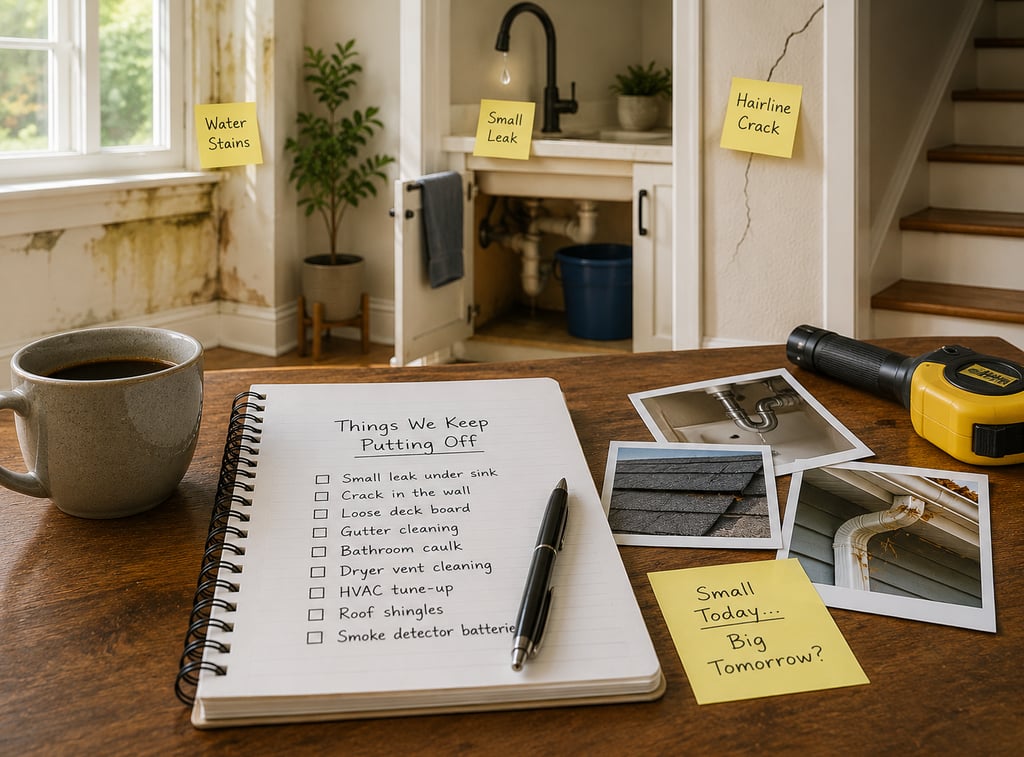
There’s a very specific kind of stress that comes from noticing something in your home and deciding, with surprising confidence, that it can wait.
Not forever.
Just for now.
A faint stain near the ceiling corner.
A drip you only hear when the weather turns a certain way.
A draft that seems mildly annoying but not exactly urgent.
A strange sound you make a mental note to investigate later.
A crack you glance at often enough to become familiar with, but not concerned enough to act on.
If this sounds familiar, welcome to a deeply human experience.
Most people do not delay practical home problems because they are careless.
They delay because life is already asking a lot.
Because decision fatigue is real.
Because uncertainty feels exhausting.
Because practical problems often arrive attached to imagined costs, inconvenient schedules, and mental energy you may not currently have.
And because, if we’re being honest, some version of maybe it’s nothing can feel emotionally comforting.
At least temporarily.
This article is not here to convince you every small household issue is secretly catastrophic.
That kind of fear-based messaging helps no one.
This is about something much more relatable: the emotional habit of postponing manageable things because life already feels full, and the quiet stress that habit sometimes creates.
Because joy isn’t about maintaining a flawless home.
But it also becomes harder to feel settled when low-grade unresolved stress keeps humming in the background.
Home Problems Rarely Feel Like Just Home Problems
A small household issue rarely stays emotionally contained.
That’s part of what makes them surprisingly stressful.
A stain is not just a stain.
A weird sound is not just a weird sound.
A recurring issue is not simply a practical inconvenience.
It often becomes a question mark.
And question marks take up mental space.
You start wondering.
Is this serious?
Is it expensive?
Can it wait?
Am I overreacting?
Will this become worse?
Should I already be doing something?
That emotional layer matters.
Because unresolved uncertainty has a way of turning simple observations into background stress.
And background stress still counts.
Your home is supposed to be one of the places where your nervous system gets to soften a little.
When uncertainty lives there too, even quietly, the emotional effect can feel bigger than the issue itself.
That does not make you dramatic.
It makes you responsive to your environment.
Which is normal.
Why “Later” Feels Like a Reasonable Strategy
Let’s be fair to procrastination for a moment.
Sometimes “later” is reasonable.
You genuinely are busy.
You have work.
Children.
Appointments.
Financial priorities.
Energy limitations.
A full schedule.
Real responsibilities.
Not every practical issue deserves immediate escalation.
That’s true.
But “later” becomes trickier when it stops being a scheduling decision and starts becoming emotional avoidance.
The difference is subtle.
A scheduling decision says:
I can address this Thursday when I actually have time.
Avoidance says:
I’ll think about this at some undefined future point when life somehow becomes dramatically easier.
We are all occasionally optimistic about this mythical future version of ourselves.
They are apparently well-rested, emotionally clear, financially prepared, and strangely available.
Real life tends to be less cooperative.
Sometimes later is practical.
Sometimes later is just uncertainty wearing a calendar disguise.
Decision Fatigue Makes Small Problems Feel Weirdly Heavy
One of adulthood’s less glamorous truths is that small decisions can become exhausting when you’ve made too many of them.
Modern life requires constant decision-making.
Meals.
Schedules.
Messages.
Bills.
Family logistics.
Work priorities.
Appointments.
Digital interruptions.
Tiny repeated choices.
So when a home issue appears, even a manageable one, it doesn’t arrive into an empty mental space.
It lands on top of everything else.
Suddenly you’re asking:
Who should I call?
Is this urgent?
What might this cost?
Should I research first?
Do I need multiple opinions?
Am I overthinking this?
Can this wait?
Even when the issue itself is relatively straightforward, the mental process can feel disproportionately draining.
That’s why people delay things they technically know how to address.
Not because they lack intelligence.
Because bandwidth matters.
And tired brains often choose postponement over additional complexity.
Hope Is Sometimes Emotional Self-Protection
Hope gets a complicated reputation.
On one hand, optimism helps.
Perspective matters.
Not every concern deserves catastrophe thinking.
On the other hand, hope occasionally becomes a quiet form of emotional self-protection.
Maybe it won’t happen again.
Maybe it looks worse than it is.
Maybe I’m imagining it.
Maybe this stays minor.
That instinct is understandable.
Sometimes even accurate.
But hope can also delay clarity when what you really feel is reluctance.
Not because you’re irresponsible.
Because bad news feels emotionally expensive before it even arrives.
People avoid uncertainty all the time.
Health questions.
Financial questions.
Difficult conversations.
Household issues.
It’s not unique to home maintenance.
Humans generally prefer manageable ambiguity over potentially inconvenient certainty.
The problem is that unresolved ambiguity still creates stress.
Sometimes more than answers would.
The Emotional Cost of Low-Grade Home Stress
Not all stress announces itself dramatically.
Some stress behaves more quietly.
It hums.
A low-grade irritation.
A recurring mental note.
A thing you vaguely remember while lying in bed.
A task you mentally postpone every time it surfaces.
This kind of stress is easy to dismiss because it doesn’t feel like crisis.
But emotional clutter still affects wellbeing.
It shortens patience.
Occupies attention.
Adds background tension.
Creates subtle relationship friction.
Makes home feel slightly less restful.
The issue may be objectively small.
The emotional impact may still be real.
That distinction matters.
Because practical peace is part of emotional wellbeing too.
Small Problems Sometimes Stay Small. Sometimes They Don’t.
This is where balanced thinking matters.
Not every household issue becomes expensive.
Not every weird sound signals disaster.
Not every inconvenience deserves urgent escalation.
Fear is not practical wisdom.
But neither is indefinite uncertainty.
Some issues genuinely remain minor.
Others quietly evolve.
Moisture concerns.
Repeated leaks.
Ventilation problems.
Electrical inconsistencies.
Structural wear.
Weather-related damage.
Recurring signs that something may be changing.
The challenge is not assuming worst-case scenarios.
It’s recognizing when prolonged guessing creates more stress than early clarity.
That’s a much healthier framework.
Not panic.
Perspective.
Household Stress Often Becomes Relationship Stress
This part deserves more attention than it gets.
Because practical home problems rarely affect only one person emotionally.
Different people respond differently to uncertainty.
One person wants immediate action.
The other prefers waiting.
One wants confirmation.
The other wants breathing room.
One interprets caution as responsibility.
The other interprets caution as anxiety.
Neither person is necessarily wrong.
But unresolved practical concerns can become symbolic.
The leak stops being about the leak.
Now it’s about financial comfort.
Risk tolerance.
Communication styles.
Responsibility.
Emotional coping habits.
This is one reason “small” issues can create outsized tension.
Because practical uncertainty often activates deeper differences in how people process stress.
The Myth of the Perfect Time
There is always a future week that looks more convenient in theory.
After payday.
After the school event.
After work calms down.
After vacation.
After the current stressful thing.
After the next deadline.
This logic makes sense.
Life does get busy.
Timing does matter.
But if we’re honest, some practical delays are not really about timing.
They’re about emotional readiness.
And emotional readiness can become a moving target.
Because difficult tasks rarely become emotionally inviting with time alone.
Sometimes the “perfect time” is simply the moment you decide continued uncertainty feels heavier than action.
That may not feel inspiring.
Still useful.
Sometimes Clarity Is Less Stressful Than Guessing
There’s something psychologically exhausting about repeatedly wondering.
Rechecking.
Mentally rehearsing.
Second-guessing.
Watching.
Waiting.
Wondering if you’re overreacting.
That emotional loop costs energy.
Which is why practical information often creates relief, even when the answer isn’t ideal.
Because clarity restores agency.
You can plan around known information.
You can make decisions around known information.
Uncertainty offers less stability.
That doesn’t mean rushing toward answers impulsively.
It means recognizing that thoughtful clarity is often emotionally easier than indefinite guessing.
For example, if repeated roofing concerns, storm-related wear, or persistent signs create ongoing uncertainty, companies like Yellowhammer are one example of the practical resources homeowners may explore when understanding the situation feels less stressful than continuing to speculate.
The broader point is the real point.
Clarity reduces emotional friction.
Perfectionism Quietly Delays Practical Progress
Some delays are not caused by avoidance exactly.
They’re caused by perfectionism.
You want to make the smartest decision.
Research properly.
Understand all options.
Ask informed questions.
Avoid mistakes.
Be fully prepared.
This sounds responsible because sometimes it is.
But perfectionism can quietly delay reasonable action.
Because complete certainty is rarely available upfront.
You may not know everything before making the first call.
You may not have all the answers before asking questions.
You may not feel emotionally prepared before taking practical steps.
That’s okay.
Progress does not require perfect readiness.
Sometimes it requires one reasonably good next step.
That counts.
Financial Anxiety Changes Decision-Making
We should name this directly.
Money stress affects practical decisions.
Unexpected home expenses can feel emotionally heavy before any actual number exists.
That anticipation alone can create avoidance.
If the issue is ignored, maybe the cost remains theoretical.
If no one confirms anything, maybe the situation stays psychologically manageable.
Again, deeply human.
Financial caution is not irrational.
But indefinite uncertainty does not automatically protect finances either.
Sometimes earlier clarity creates more options, not fewer.
The goal here is not spending impulsively.
It’s avoiding decisions driven entirely by imagined fear rather than actual information.
Those are different things.
Small Action Creates Emotional Momentum
Overwhelm thrives in stillness.
Movement changes emotional posture.
Not because the entire problem disappears.
Because uncertainty becomes action.
And action restores a sense of agency.
That action can be very small.
Take a photo.
Write the concern down.
Ask someone you trust.
Schedule one conversation.
Look at one email.
Research one practical question.
Tiny progress still matters.
People often underestimate how much emotional relief comes from simply no longer feeling stuck.
Momentum changes the experience.
Even when the larger issue remains unresolved.
Joy Does Not Require a Perfectly Managed Life
Let’s be honest.
No adult reaches a magical stage where everything is permanently handled.
Homes need maintenance.
Schedules shift.
Bodies need care.
Relationships require attention.
Finances evolve.
Systems break.
Life remains gloriously unfinished.
Joy cannot depend on flawless management.
That would be exhausting.
But emotional wellbeing does benefit from reducing avoidable background stress where possible.
That’s the difference.
This is not about perfect control.
It’s about choosing clarity, support, and practical steadiness when uncertainty becomes heavier than helpful.
That’s practical joy.
Not idealized joy.
Real joy.
The kind that makes room for imperfection while still caring for what matters.
The Takeaway
Most people do not delay home problems because they don’t care.
They delay because life is busy, uncertainty feels tiring, practical decisions require energy, and emotional bandwidth is finite.
That’s human.
Not failure.
But sometimes the stress of unresolved uncertainty quietly becomes heavier than the issue itself.
If something in your home has been living in the mental deal with later category for longer than it should, consider this your gentle reminder:
You do not need to panic.
You do not need to fix everything immediately.
But you may deserve the peace that comes from a little more clarity.