
The Decisions People Regret Delaying After Life Suddenly Gets Complicated
When life gets unexpectedly overwhelming, even simple decisions can feel heavy. Discover the practical steps people often regret delaying and how to navigate stressful seasons with more clarity, support, and self-compassion.

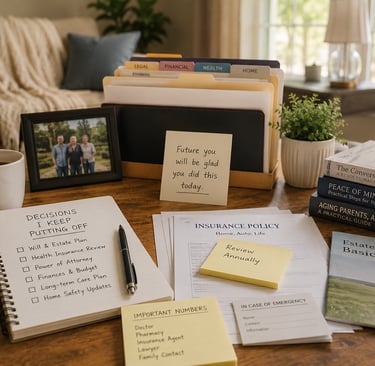
Life rarely sends a calendar invitation before it becomes overwhelming.
Most of the time, disruption doesn’t arrive in a way that feels emotionally organized. It shows up in the middle of regular life. Between errands. During a normal Tuesday. In the middle of plans you expected to keep.
One phone call.
One unexpected diagnosis.
One accident.
One difficult conversation.
One event that suddenly rearranges your priorities before your emotions have had time to catch up.
And one of the strangest parts of these moments is how quickly ordinary tasks can start feeling impossible.
Replying to messages.
Scheduling appointments.
Opening emails.
Filling out forms.
Making decisions that would normally take five minutes.
When life gets complicated suddenly, even simple choices can feel unusually heavy.
If you’ve ever experienced that, you’re not failing.
You’re human.
Stress changes how we think. Overwhelm narrows our bandwidth. Emotional uncertainty makes practical decisions feel larger than they are.
And because of that, many people delay things they later wish they had handled sooner.
Not because they were careless.
Not because they weren’t trying.
But because difficult seasons make clear thinking harder.
This article is not about doing everything perfectly.
It’s about practical compassion.
The kind that helps you notice what matters when life feels noisy.
The kind that reminds you small next steps still count.
Because joy doesn’t require pretending hard things aren’t hard.
Sometimes joy looks like clarity.
Sometimes it looks like support.
Sometimes it looks like simply making one decision that helps tomorrow feel a little lighter.
Waiting Until You Feel “Less Overwhelmed” to Start Anything
This might be the most relatable delay of all.
When life gets messy, many people assume they’ll take action once they feel calmer.
That sounds reasonable.
The problem is that overwhelm doesn’t always leave on its own.
Sometimes it lingers specifically because unresolved tasks keep circling in the background.
You tell yourself:
I’ll handle this when I can think clearly.
Tomorrow might feel easier.
I just need a little time first.
And sometimes that’s true.
Sometimes rest is the right first move.
But sometimes waiting for emotional clarity becomes a quiet form of avoidance, not because you’re irresponsible, but because uncertainty feels exhausting.
The issue is that unresolved practical tasks tend to keep asking for mental space.
The appointment you haven’t scheduled.
The form you haven’t opened.
The call you haven’t returned.
The question you haven’t asked.
These things rarely disappear simply because we’re emotionally tired.
Often, they become heavier.
This doesn’t mean you need to tackle everything immediately.
It means emotional readiness doesn’t always arrive before action.
Sometimes clarity grows because you started.
One small step can reduce more anxiety than another week of worrying.
Assuming Small Decisions Don’t Matter Right Now
Stress creates strange perspective shifts.
Big problems feel obvious.
Smaller tasks feel optional.
If life has become emotionally complicated, it’s easy to assume that “little” decisions can wait.
Drink enough water later.
Figure out transportation later.
Reply to the message later.
Confirm the appointment later.
Organize the paperwork later.
Eat something decent later.
But difficult seasons are often made easier or harder by seemingly small decisions.
Not because these actions solve everything.
Because they stabilize you.
Stress has a way of making practical care feel unimportant compared to larger problems.
But bodies still need fuel.
Schedules still need clarity.
Support still requires communication.
A little structure can reduce emotional chaos more than people expect.
The small things are often load-bearing.
Trying to Be the Strong One for Everyone Else
Some people become remarkably functional during difficult seasons.
You might even be one of them.
The person who organizes.
Responds.
Coordinates.
Checks on others.
Keeps moving.
Makes sure everyone else has what they need.
From the outside, this can look like resilience.
Sometimes it is.
Sometimes it’s survival mode wearing productivity as a disguise.
Being dependable is not a flaw.
But constantly becoming the emotionally capable one can create quiet exhaustion.
People who carry others often delay their own needs because tending to themselves feels less urgent.
Or less familiar.
Or somehow less deserved.
That mindset is understandable.
It is also unsustainable.
Support is not reserved for the people visibly falling apart.
The person holding things together may need help too.
Especially that person.
Delaying Medical Attention Because “There Are Bigger Things Going On”
This happens more often than people admit.
When life becomes complicated, physical needs can get deprioritized quickly.
A headache becomes background noise.
Pain gets minimized.
Fatigue gets explained away.
Stress symptoms become normal.
Lingering discomfort becomes something to “deal with later.”
This makes emotional sense.
If the larger situation feels urgent, smaller physical concerns can seem unimportant by comparison.
But your body does not separate itself from your circumstances.
Stress shows up physically.
In sleep disruption.
Muscle tension.
Digestive changes.
Headaches.
Exhaustion.
Pain.
And sometimes the physical issue is part of the larger problem, not a side note to it.
Ignoring your body during stressful seasons often creates additional difficulty.
Caring for physical wellbeing is not indulgent.
It is stabilizing.
Putting Off Asking Questions Because You’re Afraid of the Answers
Uncertainty has a strange emotional appeal.
It’s uncomfortable.
But it also allows possibility.
If you haven’t asked the question, maybe the answer isn’t as difficult as you fear.
If you haven’t confirmed the details, maybe things will somehow resolve themselves.
If you don’t look directly at the problem, maybe it stays emotionally manageable for a little longer.
This is deeply human.
Avoidance is often less about irresponsibility and more about emotional self-protection.
But uncertainty is rarely free.
It consumes energy.
It creates background stress.
It makes practical planning harder.
Clarity can be difficult.
But prolonged ambiguity often costs more emotionally than honest information.
You don’t need every answer immediately.
But sometimes the kindest thing you can do for yourself is replace imagined stress with real information.
Letting Paperwork Become Future You’s Problem
Paperwork is emotionally offensive during already difficult seasons.
That may be dramatic.
Still true.
Forms.
Insurance documents.
Medical records.
Emails requiring responses.
Scheduling confirmations.
Requests for information.
Identity verification.
Administrative follow-ups.
None of this feels healing.
None of it creates emotional comfort.
Which is exactly why it gets postponed.
But paperwork has a frustrating habit of becoming more stressful with time.
Deadlines pass.
Details become fuzzy.
Documents go missing.
Memory becomes less reliable.
Follow-up becomes more complicated.
The goal here is not administrative perfection.
It’s reducing preventable future stress.
Sometimes that looks like finishing everything.
Sometimes it looks like opening one email.
Downloading one form.
Writing down one deadline.
Progress still counts.
Thinking You Need to “Get Organized First” Before Seeking Professional Help
This mindset catches a lot of people.
Especially thoughtful people.
Especially capable people.
Especially people who dislike feeling unprepared.
The internal logic often sounds like:
I should understand the situation better first.
I need to organize everything before asking for help.
I don’t even know what question to ask yet.
Maybe it’s too early.
But support often creates clarity.
Not the other way around.
When difficult situations involve practical uncertainty, medical recovery, legal confusion, financial questions, or administrative complexity, early guidance can reduce stress significantly. In situations involving injury-related uncertainty, for example, resources like Wolfe, Jones may be one of the professional avenues people explore when they need clearer understanding of next steps.
The larger point matters more than the example.
You do not need to become fully organized before seeking informed support.
Sometimes support is what helps you get organized.
Mistaking Productivity for Coping
Activity can feel comforting.
There’s structure in doing.
Emails.
Cleaning.
Research.
Organizing.
Making lists.
Helping other people.
Checking tasks off.
Productivity creates movement.
Movement can feel like control.
And during uncertain seasons, control feels emotionally soothing.
But constant activity is not always the same as emotional coping.
Sometimes productivity becomes avoidance in efficient clothing.
You stay busy because stopping would create emotional silence.
And silence would require feeling things you may not be ready to feel.
Again, deeply human.
No judgment.
But worth noticing.
Being productive is not bad.
Using endless productivity to avoid rest, grief, fear, or emotional processing usually becomes expensive eventually.
Delaying Honest Conversations
Stress makes communication harder.
Especially honest communication.
It’s difficult to explain overwhelm when you barely understand your own emotions.
It’s difficult to ask for help when you’re used to being dependable.
It’s difficult to tell people you’re struggling when you’re trying to stay composed.
So important conversations get delayed.
With partners.
Family.
Friends.
Employers.
Support systems.
Care providers.
Sometimes because you want to protect other people.
Sometimes because you don’t know what to say.
Sometimes because saying it aloud makes the situation feel more real.
But silence creates its own complications.
People who care about you cannot respond to realities they don’t know exist.
The conversation does not need to be polished.
You do not need the perfect words.
Sometimes honesty sounds like:
I’m having a hard time.
I’m overwhelmed.
I don’t know what I need yet.
I may need some support.
That is enough.
Comparing Your Stress to Someone Else’s Bigger Problem
This is one of the quieter forms of self-dismissal.
Maybe your situation feels difficult.
But then you think about someone dealing with something objectively worse.
And suddenly your own stress feels illegitimate.
You tell yourself:
Other people have bigger problems.
I should be handling this better.
This doesn’t justify feeling this overwhelmed.
Perspective can be healthy.
Self-erasure is not.
Pain is not a competition.
Difficulty does not require universal ranking.
Your experience matters because you are experiencing it.
Compassion does not need comparative justification.
That mindset alone helps many people seek support sooner.
Waiting for the Perfect Time to Rest
Rest often becomes conditional.
After the paperwork.
After the appointments.
After the crisis passes.
After things settle down.
After the next deadline.
After one more task.
The problem is that difficult seasons rarely become tidy on schedule.
Life does not always present a clean moment where everything suddenly feels manageable enough for rest.
Meanwhile exhaustion quietly accumulates.
And exhaustion makes every decision harder.
Rest is not the reward for finishing all hard things.
Sometimes rest is what makes hard things more manageable.
That can mean:
a nap
a slower morning
asking someone else to help
turning off notifications
eating something real
taking a walk
sitting in silence
not solving something immediately
Small recovery matters.
Expecting Yourself to Think Clearly While Emotionally Flooded
This deserves direct repetition.
Stress changes thinking.
Memory becomes less reliable.
Patience gets shorter.
Attention fragments.
Decision-making feels harder.
Simple tasks require more effort.
This is not weakness.
It is human nervous system reality.
Which means practical compassion matters.
Write things down.
Simplify decisions.
Reduce unnecessary commitments.
Ask people to repeat information.
Accept imperfect functioning.
Difficult seasons are not the time to judge yourself by calm-season standards.
Forgetting That Stability Often Returns Through Small Steps
When life feels overwhelming, dramatic solutions seem emotionally appealing.
A breakthrough.
A complete plan.
A clean answer.
Total clarity.
Sometimes those happen.
Usually stability returns more quietly.
One returned phone call.
One appointment scheduled.
One honest conversation.
One form completed.
One meal eaten.
One supportive text sent.
One decision made.
One hour of rest.
Progress often looks unimpressive from the outside.
That doesn’t make it less real.
Small steps restore momentum.
Momentum restores steadiness.
Steadiness creates emotional breathing room.
That’s how many difficult seasons actually begin to shift.
Joy Still Belongs in Imperfect Seasons
Joy Digital Mag would be missing the point if we implied joy only belongs to people whose lives are currently neat.
That’s not how real life works.
Some seasons remain uncertain longer than expected.
Some questions stay unanswered.
Some situations take time.
And still.
Joy can exist there.
Not forced positivity.
Not pretending everything is fine.
Real joy.
The kind found in support.
Relief.
Small kindnesses.
Unexpected laughter.
Rest without guilt.
Clarity after confusion.
Being cared for.
Feeling less alone.
A little steadiness inside messy circumstances.
Life getting complicated does not disqualify you from moments of lightness.
The Takeaway
When life suddenly gets complicated, practical decisions often become emotionally heavier than they look.
That’s normal.
The goal is not flawless coping.
The goal is noticing where overwhelm may be quietly delaying the support, clarity, care, or action that could make life easier.
If you are in a difficult season right now, this matters:
You do not need perfect clarity to take one helpful next step.
You do not need to earn support through exhaustion.
And you do not need life to be fully sorted before making room for steadiness, support, and even small moments of joy again.